

Table of Contents
- What You'll Need Before You Shop
- Understanding SxS Lug Pattern Measurements
- UTV Wheel Offset Explained
- Beadlock vs Non-Beadlock Wheels
- Matching Rim Size, Width, and Load Rating to Your Machine
- How to Choose SxS Rims by Terrain and Riding Style
- Common Fitment Mistakes to Avoid
- Conclusion
- Frequently Asked Questions
Last Updated: September 24, 2026
What You'll Need Before You Shop
Getting the right rims starts with four numbers: bolt pattern, stock offset, rim diameter, and load rating. Write those down before you shop. This guide from SiC Powersports Ltd. covers how to choose SxS rims that bolt on, clear your suspension, and survive your terrain.
A rim that fits a 2019 Can-Am Outlander won't necessarily fit a Polaris Ranger, even if both run 14-inch wheels. Bolt pattern, offset, and centre bore all have to line up.
What you'll need:
- A tape measure or caliper
- Your machine's make, model, and year
- A flat, level surface to work on
- Your current wheel's offset and width (stamped on the back of most rims)
- The load rating for your vehicle, usually in the owner's manual
Understanding SxS Lug Pattern Measurements
A lug pattern is the stud count plus the distance between them, written like 4x137 or 4x156. The first number is the stud count; the second is the diameter of the circle those studs sit on, in millimetres.
Get this wrong and nothing else matters. A 4x137 wheel will not seat on a 4x156 hub, and adapters won't make it safe, the number one reason online wheel orders get shipped back.
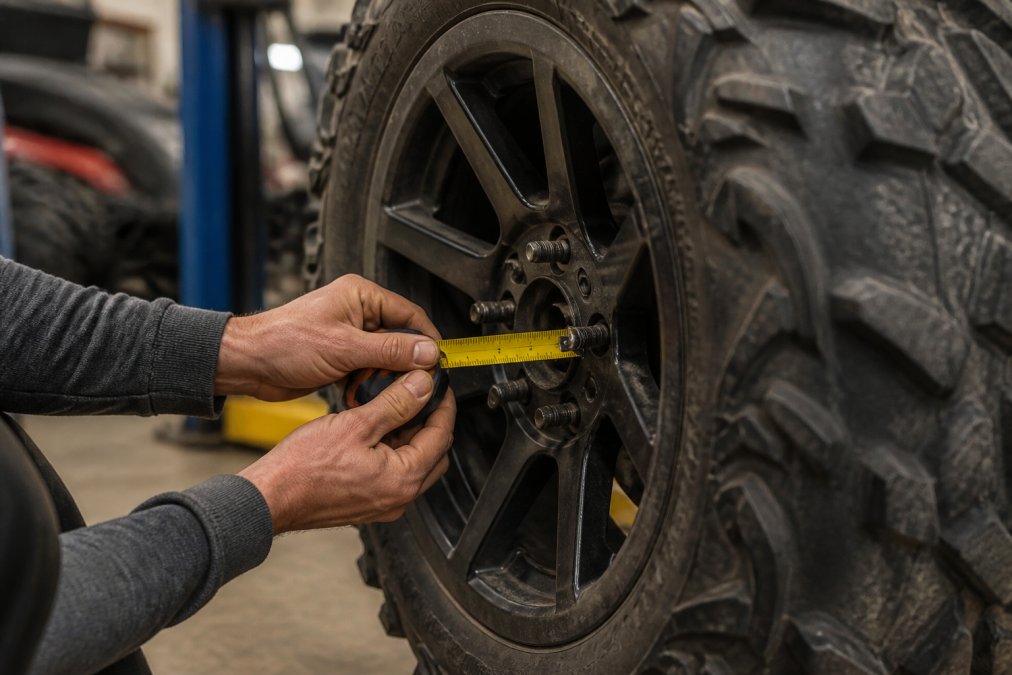
How to Measure Your Bolt Pattern in Minutes
Measuring takes about five minutes, and the method depends on your stud count.
For a four-lug hub:
- Pick two studs directly across from each other
- Measure from the centre of one stud to the centre of the opposite stud
- That distance, in millimetres, is your bolt circle
For a five-lug hub, measure from the centre of one stud to the outer edge of the stud two positions over. For six-lug hubs, measure centre-to-centre on opposite studs, same as four-lug.
Expected result: A number matching a standard pattern like 4x137, 4x156, or 4x110. If it lands between two standards, re-measure. Hub centric and lug centric wheels both rely on this number being exact.
UTV Wheel Offset Explained
Wheel offset is the distance from the wheel's mounting surface to its centreline, in millimetres. Positive offset tucks the wheel inward; negative pushes it outward; zero puts it dead centre.
Backspacing measures the same idea differently: the distance from the mounting surface to the inner edge of the rim. Offset is the manufacturer's spec; backspacing is what you can measure with a straightedge.
How Offset and Backspacing Affect Handling
Change your offset and you change your suspension geometry. Push wheels outward with negative offset and you widen the track, increasing scrub radius and forcing bearings and ball joints to work harder. Steering also gets heavier.
Stay close to stock offset and your machine handles the way the engineers intended, which matters most on a utility SxS that spends its life loaded with tools or feed. Wheel spacers widen your stance but add a failure point and often push you past legal track-width limits on public trails.
What Offset Change Actually Does to Your Drivetrain and Suspension
Changing offset moves the tire's contact patch relative to the steering axis, and that single change cascades through the whole machine.
MSA M37 14x7 4x156 +10 offset →
Scrub radius and steering effort. Scrub radius is the distance between where the steering axis meets the ground and the centre of the tire's contact patch. Stock offset keeps this near zero, so your machine steers lightly and tracks straight. Push the wheel outward and scrub radius grows: heavier steering, more kickback, and faster edge wear.
CV joint angle. On a lifted or offset-widened machine, the front axle CV (constant velocity) joints run at a steeper angle, meaning more heat, more friction, and shorter boot life. A cracked boot throws grease and grit into the joint, and a failed CV on the trail is a tow, not a repair. Riders who widen their track with aggressive negative offset replace CV boots and joints far sooner than the manual suggests.
Wheel bearing load. Bearings are designed around a specific load line. Move the wheel outward and you increase the lever arm acting on the bearing. The bearing doesn't fail immediately; it fails early. A machine that would normally get thousands of kilometres from a set of bearings may see that life cut noticeably with a wide offset.
Ball joints and tie rod ends. The same lever-arm effect applies to the steering and suspension pivots.
The Practical Rule
Stay within roughly 10-15 mm of stock offset to keep the drivetrain and suspension in their designed operating window. If you need a wider stance for sidehills or deep ruts, accept that you're trading component life for capability, and check CV boots, wheel bearings, and ball joints more often.
Beadlock vs Non-Beadlock Wheels
Beadlock wheels use a bolted ring to clamp the tire's bead against the rim, letting you run very low tire pressure without the bead popping off. Non-beadlock wheels rely on air pressure alone.
| Wheel Type | Best For | Trade-off |
|---|---|---|
| Beadlock | Rock crawling, low-pressure traction | Heavier, needs torque checks |
| Non-beadlock | Trail riding, utility work, sand | Cannot safely air down as far |
Matching Rim Size, Width, and Load Rating to Your Machine
Rim diameter and width have to match your tire's intended fitment, and the load rating has to cover your machine plus everything you load onto it. Get all three right and the wheel disappears into the background. Get one wrong and you'll feel it.
| Wheel | Size | Bolt Pattern | Offset | Load Rating |
|---|---|---|---|---|
| MSA M37 Brute Beadlock | 14x7 | 4x156 | +10 | Beadlock |
| MSA M12 Diesel | 14x7 | 4x156 | +10 | Standard |
| MSA M21 LOK Beadlock | 14x7 | 4x137 | 0 | 453.51 kg |
| MSA Commander MA055 | 15x7 | 4x137 / 4x156 | +10 | 566.89 kg |
How to Choose SxS Rims by Terrain and Riding Style
Terrain decides more of your wheel choice than any spec sheet. A rim that's perfect for sand will frustrate you in rock gardens, and a rock-ready beadlock is overkill for a machine that mostly hauls firewood.


Common Fitment Mistakes to Avoid
The mistakes that cost riders the most money are the boring ones: wrong bolt pattern, guessed offset, ignored load rating.
When to Repair a Bent Rim vs. Replace It
A bent rim is not automatically a dead rim. The decision comes down to where the bend is, how severe it is, and what the wheel is made of.
Conclusion
Choosing SxS rims comes down to four numbers and one honest look at how you actually ride. Measure your bolt pattern, match your offset, respect your load rating, and pick the wheel type that fits your terrain instead of the one that looks best in a photo.
Frequently Asked Questions
How do I measure my SxS lug pattern?
Count the number of lug studs on your hub, then measure the distance between the centers of two studs. For a 4-lug hub, measure straight across from stud to stud. For a 5-lug hub, measure from the back edge of one stud to the center of the stud two positions over. That gives you the bolt pattern, such as 4x137 or 4x156. Check your owner's manual or the current wheel's stamp to confirm before ordering.
Do I need beadlock wheels for trail riding?
Beadlock wheels let you run lower tire pressure without the bead popping off the rim, which improves traction in mud, sand, and rock. If you mostly ride groomed trails at standard pressure, non-beadlock rims are lighter, cheaper, and need less maintenance. Riders who push hard in technical terrain usually get more value from beadlocks.
What is the difference between wheel offset and backspacing?
Offset is the distance from the wheel's mounting surface to the centerline of the rim, measured in millimeters. Positive offset tucks the wheel inward; negative pushes it outward. Backspacing is the distance from the mounting surface to the inside edge of the rim, measured in inches. Offset is the spec most SxS wheel listings use. Changing either one shifts where the tire sits and can affect scrub radius and bearing load.
How do I choose SxS rims that fit my machine and terrain?
Start with your bolt pattern, center bore, and rim diameter. Then pick offset based on how much clearance you need and whether you want a wider or narrower stance. Match load rating to your vehicle's weight plus cargo and passengers. For mud and rock, a 14-inch beadlock with a 7-inch width works well. For trail and light utility use, a 14x7 non-beadlock in aluminum alloy keeps weight down.